ISO 9001 Certification UK: Your Comprehensive Guide
Estimated reading time: 12 minutes
Key takeaways
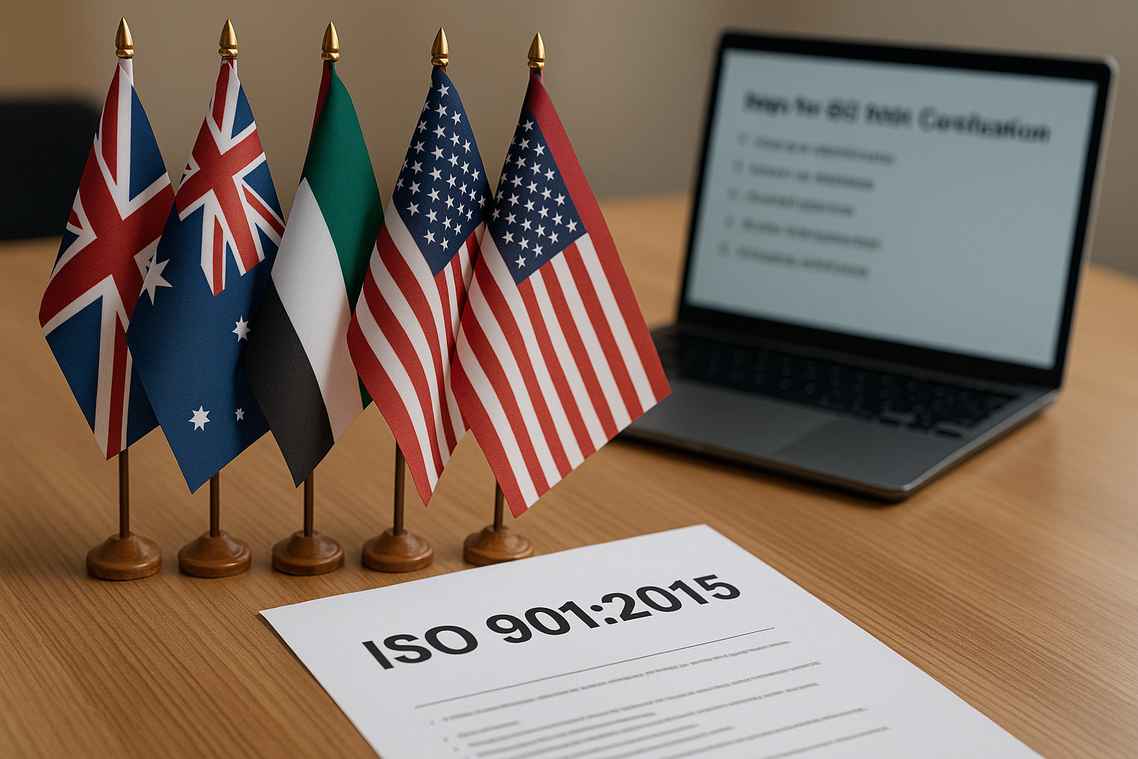
ISO 9001 certification uk helps you build a strong, process-based quality management system that wins trust and opens doors—especially for UK tenders and private contracts. You’ll learn what ISO 9001 is, how the certification process works, what to expect in the UK (and how it compares with Australia, Dubai, the USA, and Canada), what it costs, and how to choose the right accredited certification body. Simple, practical, and built so you can take action fast.
Table of contents
ISO Certified QMS
If you’re chasing growth and bigger contracts,ISO 9001 certification ukis one of the fastest ways to show buyers you run a serious operation. It signals you’ve got a reliable quality management system, not just good intentions. And that can mean better tenders, fewer errors, and happier customers. Let’s get you there—without the jargon.
Understanding ISO 9001 certification
ISO 9001 is the world’s most popular quality management standard. In plain English, it lays out the requirements for a process-based quality management system (QMS)—how you plan your work, control it, measure it, and improve it over time. That last part matters. Because the thing is, ISO 9001 expects continual improvement, not a one-and-done badge. Understanding the Basic Requirements for ISO 9001 Certification
What’s the purpose? Better quality, stronger customer satisfaction, and a culture of ongoing improvement that sticks. That’s not fluff—that’s how the standard is designed to work across any industry or size of business.
Core benefits you can expect:
Better process control (clear steps, less guesswork)
Higher customer satisfaction (you deliver what you promised)
A competitive edge when bidding for contracts (public and private)
Evidence-based decision-making (use data, not gut)
Boosted employee engagement (people know what good looks like)
These points are all consistent with the requirements and intent of ISO 9001:2015 and align with guidance from trusted sources like British Assessment and Brighter Compliance.
ISO 9001 certification process
Here’s the simple version. You plan, you implement, you check, and you prove it to an accredited auditor. Let’s break it down step by step with the UK context in mind.
1) Preparation and scoping
Get clear on what parts of your business the QMS will cover. That’s your “scope” (ISO 9001:2015 Clause 4.3). If you’re a UK SME, this might include sales, purchasing, operations, and customer support. Define it so everyone understands what’s in—and what’s out.
Do a gap analysis against ISO 9001:2015 requirements. This tells you what you already do well and where you’ve got holes to fill. Document your policies, set quality objectives, assign responsibilities, and train your team so they can actually live the system day to day. Understanding ISO 9001 Certification Cost: A Comprehensive Guide for Businesses
Try our free gap analysis worksheet to help you get started on your ISO 9001 certification journey. Free Gap analysis tool link https://free.falconquality.com/home
Quick prep checklist:
Define QMS scope (Clause 4.3)
Write your quality policy and set measurable quality objectives (Clauses 5.2 and 6.2)
Map key processes (inputs, outputs, controls, and owners)
Train staff on roles and the basics of quality management
Capture customer requirements and how you review them
Set up evidence records (competence, equipment calibration, etc.)
2) Internal audits and management review
Run internal audits to test your system. These are friendly checks by trained internal auditors to see if your processes match your procedures. Fix issues early. A Comprehensive Guide on How to Conduct Internal Audit for ISO 9001: Best Practices and Tips
Then hold a management review. It’s a formal meeting where leadership looks at performance, risks, opportunities, and resources—and decides on improvements. This keeps the QMS aligned with your strategy and not just a box-ticking exercise.
3) Third-party audit and certification
Pick a UKAS-accredited certification body in the UK. This matters. UKAS accreditation gives your certificate real weight with buyers and procurement teams. How to Choose the Right ISO 9001 Certification Body for Your Business
The audit comes in two stages:
Stage one: document review. The auditor checks your documented system to see if you’re ready.
Stage two: on-site assessment. The auditor samples your processes, interviews people, and reviews records to confirm the system works in practice.
If the auditor finds non-conformities, you’ll address them and show evidence of correction. Then—drumroll—you get certified.
4) Typical timeline
Most UK SMEs can expect 6–18 months from start to certificate. It depends on your starting point, complexity, and how quickly you close gaps.
5) Documentation requirements (ISO 9001:2015)
You don’t need a pile of binders. But you do need the right set of documents and records:
QMS scope statement
Quality policy and quality objectives (Clauses 5.2 and 6.2)
Records of competence (training, qualifications)
Calibration records (for measuring equipment)
Customer requirements review records
Keep it practical. Keep it current. And keep it where people can find it.
ISO 9001 certification uk
Let’s talk about the UK specifics. ISO 9001:2015 is the current version in use. Certification is voluntary, but many public sector tenders and private contracts ask for it—or strongly prefer it. So if you want to be in the conversation, it pays to have that certificate. The Benefits of ISO 9001 Certification: How It Drives Quality, Efficiency, and Growth
UKAS accreditation matters because it ensures official recognition. Buyers know what UKAS stands for, and they trust certificates issued under that system. Common UKAS-accredited certification bodies include BSI, SGS, and NQA (among others).
What about cost? A typical UK SME might spend around £5,000–£15,000, depending on size and scope. That range usually covers audit and certification fees. Your internal costs (time, training, fixing issues) are in addition.
Real-world results? UK SMEs often report:
More contract opportunities (especially where ISO 9001 is a stated requirement)
Improved customer retention driven by consistent service and fewer errors
And that’s the point: ISO 9001 isn’t just a badge. It’s a way to run your business so customers feel the difference.
ISO 9001 certification australia
ISO 9001 certification australia follows the same ISO 9001:2015 guidelines. The key local difference is accreditation: in Australia, look for certification bodies accredited byJAS-ANZ. That stamp shows your certificate meets accepted standards in the region.
Process flow looks familiar:
Scope your QMS
Do a gap analysis
Implement processes and train your team
Run internal audits and a management review
Undergo third-party audits to certify
Local angle: tender requirements and market credibility. Many buyers in Australia want to see ISO 9001 on your profile because it signals consistent quality management and customer satisfaction. Check your state or industry procurement guidance for details that apply to your sector.
ISO 9001 certification in dubai
ISO 9001 certification in dubai follows ISO 9001:2015 as well. Certification bodies may be accredited by EIAC or by other international accreditation bodies recognized in the UAE. The key is choosing a body whose accreditation your customers and regulators accept.
Your steps are the same: align your QMS with ISO 9001, run internal audits and management reviews, and then complete certification audits. If you operate in a free zone, pay attention to any local business requirements that might influence scope or documentation. Good news—ISO 9001 supports both mainland and free zone setups because it’s process-based and flexible.
Benefits in Dubai’s fast-moving market:
Stronger credibility with customers and partners
A clearer system for growth and scaling
Better control of suppliers and service delivery
ISO 9001 certification in usa
ISO 9001 certification in usa is recognized across industries, from manufacturing to services. In the US, look for certification bodies accredited by ANAB. That mark helps your certificate carry weight in supply chains and with major buyers. How to Get ISO 9001 Certification: Step-by-Step Guide to Achieving Organizational Excellence
The process stays the same:
Scope and gap analysis
Implementation and training
Internal audits and management review
Stage one and stage two audits
Why it matters in the US:
Buyers see reduced risk when you follow a proven quality management system
Many supply-chain partners prefer (or require) ISO 9001 certificates
Your teams gain clarity, which often reduces rework and delays
ISO 9001 certification canada
ISO 9001 certification canada is widely recognized across public and private sectors. In Canada, accreditation may come viaSCCand/orANAB, so pick a certification body that aligns with your market.
The approach mirrors the UK and US:
Define your scope and run a gap analysis
Put processes and controls in place
Audit internally, then complete external audits
For North American trade, ISO 9001 helps you speak the same quality language as partners and agencies across the border. It signals you manage risk, measure performance, and aim for customer satisfaction—consistently.
Choosing the right ISO 9001 certification body
Picking the right partner makes your life easier. And it protects the value of your certificate.
What to look for:
Proper accreditation by the right national body:
UK: UKAS
Australia: JAS-ANZ
Dubai/UAE: EIAC or recognized international accreditation
USA: ANAB
Canada: SCC and/or ANAB
Sector expertise. Ask for examples in your industry.
Reputation and audit style. You want fair and rigorous, not nitpicky theater.
Support services. Some offer pre-assessment or clear guidance on timelines and evidence.
Simple comparison at a glance:
UK: UKAS-accredited bodies (e.g., BSI, SGS, NQA)
Australia: JAS-ANZ-accredited bodies
Dubai/UAE: EIAC or recognized international accreditations
USA: ANAB-accredited bodies
Canada: SCC- and/or ANAB-accredited bodies
Best practices for a smooth process:
Be upfront about your scope, sites, and headcount
Align on audit dates and evidence expectations early
Keep communication open—ask questions, share risks, plan fixes
Use internal audits to stress-test before the external audit
How to Choose the Right ISO 9001 Certification Body for Your Business
ISO 9001 certification costs
Let’s talk money. What should you budget?
UK: Many SMEs spend roughly £5,000–£15,000 for audit and certification fees. The exact amount depends on size and scope.
Australia, Dubai, USA, Canada: Expect similar overall ranges, adjusted by your accreditation body, business size, number of sites, and audit days.
Don’t forget the extras:
Consultant support (if you bring one in)
Internal training time
Fixing non-conformities (process changes, calibration, extra training)
Smart budgeting tips:
Get quotes from multiple accredited certification bodies
Share accurate scope details so quotes are realistic
Plan internal resources early—auditors will want records and people available
Use a gap analysis to avoid costly last-minute fire drills
Understanding ISO 9001 Certification Cost: A Comprehensive Guide for Businesses
ISO 9001 certification resources
Want to go deeper with trusted info? Start here:
Accreditation bodies: UKAS (UK), JAS-ANZ (Australia), EIAC (Dubai), ANAB (USA), SCC (Canada)
Further reading and practical guides:
These resources cover the ISO 9001:2015 requirements, documentation expectations, and the end-to-end certification process.
FAQs
Q: How long does ISO 9001 certification uk take for an SME?
A: Many UK SMEs complete certification in about 6–18 months, depending on their starting point and complexity.
Q: What documents are mandatory for ISO 9001:2015?
A: You’ll need your QMS scope, quality policy, quality objectives, and key records like competence, calibration, and customer requirements reviews.
Q: Do I need a UKAS-accredited body for UK recognition?
A: Yes, choosing a UKAS-accredited certification body helps ensure your certificate is officially recognized and respected in the UK.
Q: Is ISO 9001 certification australia recognized internationally?
A: Yes. ISO 9001 is an international standard. Select a JAS-ANZ–accredited certification body so your certificate carries weight locally and abroad.
Q: Who accredits in the USA and Canada?
A: In the USA it’s primarily ANAB. In Canada, accreditation includes SCC and ANAB.
Q: What’s the difference between stage one and stage two audits?
A: Stage one reviews your documentation and readiness. Stage two checks real-world implementation through interviews, records, and process sampling.
Q: Will ISO 9001 help with tenders?
A: Often, yes. Many public and private tenders ask for ISO 9001 or award points for it. Always check the specific tender requirements.
Conclusion & Next Steps
ISO 9001 helps you build a practical quality management system that delivers better control, fewer errors, and happier customers—and it shows up where it counts: tenders, contracts, and retention. For the UK market, ISO 9001 certification uk can be the difference between getting shortlisted and getting sidelined. The same holds across Australia, Dubai, the USA, and Canada, with local accreditation bodies giving your certificate the recognition it deserves.
So, what’s next? Do a quick gap analysis, set your scope, and speak with an accredited certification body about a readiness assessment. Understanding the Basic Requirements for ISO 9001 Certification A clear plan now means a smoother audit later. You’ve got this.
