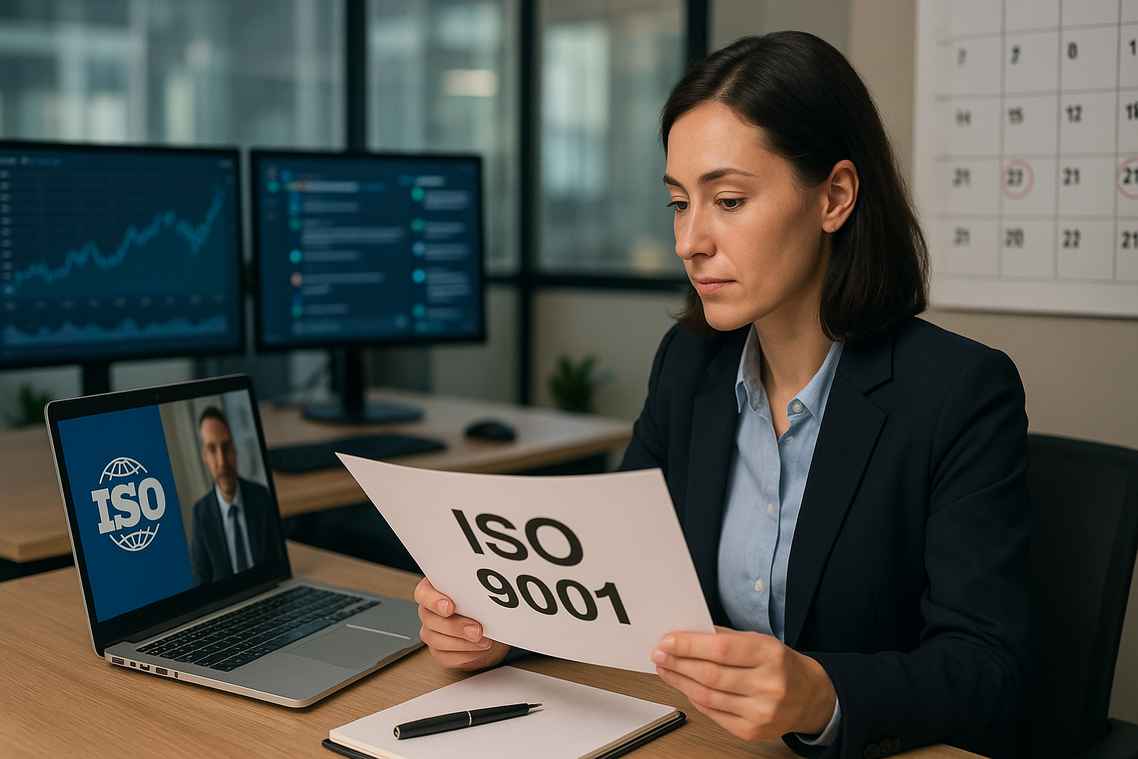
ISO 9001 Certification Online
Your guide to getting certified without leaving your desk
Estimated reading time: 12–15 minutes
Key takeaways
Getting ISO 9001 certification online lets you learn, prepare, and complete audits without travel. You can train at your pace, work with accredited certification bodies through secure portals, and schedule remote audits that fit your calendar. Pick a recognized provider, build your quality management system (QMS) with real evidence, and you can go from unsure to audit-ready in weeks or months—depending on your starting point.
Table of contents
ISO 9001 certification online: why going digital just makes sense
ISO 9001 training certification: benefits of learning online
ISO 9001 lead auditor certification online: the advanced track
ISO 9001 certification provider: how to choose the right one
ISO 9001 certification online success stories: what it looks like in practice
Online ISO 9001 is booming. ISO 9001 certification online means you can complete training, prepare your documentation, and go through audits—without flights or long on-site visits. Faster. More flexible. And easier to fit around real work.
And here’s the kicker: accredited bodies now deliver the full journey through digital learning portals, remote audits, and virtual exams. Demand for remote options keeps growing as more teams shift to digital-first workflows (see Quadraconsulting’s overview of benefits and changes to ISO 9001).
ISO 9001 certification online: why going digital just makes sense
If you’re juggling a million priorities, remote certification is a breath of fresh air. ISO 9001 certification online is delivered by accredited providers using secure portals, video calls, and digital evidence reviews. That means training modules you can pause, resume, and rewatch. Audits you can schedule around peak production or customer work. And exams you can take from your quiet conference room.
According to Quadraconsulting, interest in remote and blended approaches has climbed as companies adopt more digital processes. No surprise there. When your documents, records, and dashboards already live online, remote audits fit like a glove.
How it works in plain terms:
You learn through an online platform (courses, videos, quizzes).
You implement or tune your QMS and upload evidence.
A qualified auditor reviews your system remotely, interviews your team, and checks records.
You sit a virtual exam if your program includes one.
You receive your certificate from an accredited certification body if you meet the requirements.
So yes—you can do the whole thing online, end-to-end.
ISO 9001 certification: what it is and why it matters
ISO 9001 is the world’s most-used standard for Quality Management Systems (QMS). It lays out the criteria for how you run and improve your processes so you can deliver consistent quality—every single time.
A few key points:
It’s about consistent quality and continuous improvement (both Quadraconsulting and PECB emphasize this).
It doesn’t tell you exactly how to run your processes. Instead, it defines a framework of principles you tailor to your business, then get audited against.
When you use ISO 9001 certification services, an outside, accredited body audits your QMS. If you meet the requirements, you’re certified.
Why do companies care? Because certification boosts credibility, streamlines how work gets done, and improves customer satisfaction (as highlighted by CMTC). It helps you find issues earlier, prevent repeats, and keep turning the improvement wheel. And when a big customer asks, “Are you ISO 9001 certified?” you can say yes and back it up with a real certificate.
ISO 9001 training certification: benefits of learning online
Going online has real upside—especially for busy teams.
Flexibility: You can learn on your own schedule. Ten minutes at lunch. A deep dive on Friday afternoon. Or a weekend sprint if that’s your style.
Cost-effectiveness: Remote programs cut travel and minimize downtime (Quadraconsulting points to the logistical advantages of remote setups).
Fewer disruptions: Self-paced modules mean you train without shutting down production or pausing service.
Global access: You’re not limited by geography. If the best program is halfway around the world, it’s still a click away.
Better retention: Rewatching segments and using interactive quizzes helps the ideas stick.
And because many providers bundle ISO 9001 training certification with templates and coaching, you move from “I think I get it” to “We’re actually doing this” much faster.
ISO 9001 certification services: what you can get online
Not all ISO 9001 certification services are equal. The good ones bundle what you actually need to get audit-ready and stay that way.
Typical services you’ll see online:
Consulting and gap assessments
QMS documentation support (policies, procedures, process maps)
Remote internal audits and readiness reviews
External certification audits
Ongoing mentoring and surveillance audit support
ISO 9001 training certification programs for different roles
And yes—accreditation matters a lot. Look for certification bodies recognized by reputable accreditation groups connected to the International Accreditation Forum (IAF). That’s how you know your certificate will hold up with customers and partners.
Here’s a quick, scannable comparison of common service types:
Pro tip: Ask if the package includes online mentoring, practical templates, and post-cert guidance. Those three save time—and a lot of headache.
ISO 9001 training: how to nail the cer tification prep
Training is the difference between “we filled out forms” and “we built a living system that works.” PECB notes that adequate training is essential. Couldn’t agree more.
Common training formats:
Self-paced courses: Learn at your speed, with videos, quizzes, and checkpoints.
Live webinars: Instructor-led sessions with Q&A so you can ask the awkward questions (the best learning moments).
Interactive modules: Case studies, role plays, and scenario-based tasks to build real confidence.
What to look for inside a strong ISO 9001 training certification program:
Practice exams so you know the style and difficulty before test day.
Access to case studies from different industries.
Hands-on exercises where you map a process, find risks, and write a practical procedure (not just theory).
Clear guidance on clause-by-clause requirements and how they show up in real operations.
One more thing: schedule time to apply what you learn right away. Even 30 minutes after each module to tweak a form or draft a procedure builds momentum.
ISO 9001 certification for individuals: boost your career
You don’t need to be a quality manager to benefit. ISO 9001 certification for individuals can make your resume pop and open doors—especially if you own key processes or manage suppliers. According to PECB, individuals often increase their marketability after earning certification. Hiring managers notice.
Good news on eligibility: there are usually no strict prerequisites. A basic understanding of quality management helps, but you can learn that during training.
What you’ll be tested on:
The intent of ISO 9001 clauses (what they ask for and why)
How to document processes and records properly
Evidence that shows your QMS is working
Risk-based thinking and continuous improvement
If you’re new to the standard, start with a foundation or internal auditor course. If you’re leading change, aim higher—then use those skills to drive real improvements on the job.
ISO 9001 lead auditor certification online: the advanced track
Think of the lead auditor as the orchestra conductor of audits. Planning. Running the audit. Guiding the team. Reporting clearly. And making sure the findings actually help.
ISO 9001 lead auditor certification online usually follows a clear path:
Coursework on audit principles: ISO 19011 guidance, audit planning, sampling, interviewing, and reporting.
Mock audit exercises: Practice writing nonconformities, running opening/closing meetings, and coaching auditees.
Final exam or assessment: Prove you can plan and conduct an audit end-to-end.
Lead auditors play big roles in both internal and external audits. They line up the right evidence, keep audits objective, and help organizations spot improvement opportunities—not just pass/fail points. If you like structured problem-solving and guiding teams, this track fits.
ISO 9001 certification process online: step-by-step
Here’s the simple path to complete ISO 9001 certification online from start to finish:
Select an accredited body
– Verify the certification body is recognized by credible accreditation bodies tied to the IAF (like ANSI or UKAS). Confirm they offer remote audits and secure portals for document exchange. How to Choose the Right ISO 9001 Certification BodyEnroll in required training
– Choose ISO 9001 training certification that fits your role and timeline.
– Make sure it includes practice exams and practical exercises.Implement your QMS and gather evidence
– Map key processes, set measurable objectives, and define responsibilities.
– Build records that show your system works (training logs, inspection results, corrective actions).
– Run at least one internal audit and a management review. Understanding the Basic Requirements for ISO 9001 CertificationUndergo the remote audit
– Stage 1 checks your documentation and readiness.
– Stage 2 tests implementation—interviews, records, and real outcomes.
– Prepare for clear, fast responses to any findings.Receive certification (if you pass)
– If there are nonconformities, close them promptly.
– Your certificate is issued by the accredited body.
Timeline? It varies. If you’re nearly there, it can be a few weeks. If you’re building your system from scratch, expect a few months. The thing is, your speed depends on readiness and how quickly you can gather real evidence.
“Try our free gap analysis worksheet to help you get started on your iso 9001 certification journey. Free Gap analysis tool”
ISO 9001 certification provider: how to choose the right one
Choosing the right partner can save you months. Maybe years.
What to check, line by line:
Accreditation: Confirm recognition by bodies like ANSI or UKAS, aligned with the International Accreditation Forum (IAF). No accreditation, no dice.
Credibility and track record: Read reviews, ask for references, and check industry experience.
Scope coverage: Make sure their accreditation covers your industry and locations.
Support depth: Do they offer mentoring, templates, and post-cert guidance—or just an audit date?
Customer service: Fast, clear answers matter when you hit a snag.
Learning resources: Solid study materials, practice exams, and case studies help you pass the first time.
If a provider bundles ISO 9001 certification services with training and ongoing support, that’s often the smoothest route. You get one team that understands your system end-to-end.
ISO 9001 certification cost: what to budget for
Let’s talk money—without the guesswork. Exact prices vary, but you can plan around the main buckets:
Training costs: Courses for your team (from foundation to internal auditor to lead auditor).
Documentation and mentoring: Templates, workshops, and coaching to build your QMS the right way.
Certification audit fees: Stage 1 and Stage 2 audits from an accredited body.
Ongoing surveillance: Annual checks to keep your certificate valid.
Internal time investment: Project time to run audits, close actions, and improve processes.
Some providers bundle training and audit fees; others price them separately. Either way, weigh cost against results.CMTC points to a strong return: improved efficiency, higher credibility, and better customer satisfaction. And those open up access to new markets and contracts. So while there’s an upfront investment, the long-term gains usually outweigh it—especially when your QMS reduces rework and keeps customers happy. Understanding ISO 9001 Certification Cost: A Comprehensive Guide for Businesses
ISO 9001 certification online success stories: what it looks like in practice
What actually changes once you’re certified online? A few patterns show up again and again.
Smoother processes: Teams document how work should flow, then follow it. Less “who owns this?” and more “done.”
Fewer errors: Standard work and clear records mean less scrap, rework, and firefighting.
Faster turnaround: When roles and checkpoints are clear, products and services move faster.
Happier customers: Companies often report improved customer satisfaction after certification (echoed by Quadraconsulting and CMTC).
Morale bump: People like knowing what “good” looks like—and hitting it.
Imagine a small manufacturer that used online mentoring and remote audits. They standardized inspections, trained operators, and started tracking corrective actions. Within a cycle, they saw fewer defects and easier handoffs. Or a professional services firm that switched to self-paced training and virtual internal audits. They cut back-and-forth emails and responded to client requests faster. Different industries, same core wins: clarity, consistency, and continuous improvement.
FAQs
Q1: Is ISO 9001 certification online valid?
A: Yes—if your certificate is issued by an accredited certification body recognized by credible accreditation groups tied to the IAF. Always verify accreditation.
Q2: How does ISO 9001 training certification work virtually?
A: You learn through an online portal with videos, quizzes, and assignments. Many programs include live webinars, practice exams, and case studies to lock in the knowledge.
Q3: Do we still need audits if it’s online?
A: Yes. You’ll complete a remote audit with interviews, document reviews, and evidence checks. It’s the same rigor, delivered virtually.
Q4: How often do we renew certification?
A: Typically every three years, with surveillance audits in between to confirm ongoing compliance (as noted by Quadraconsulting).
Q5: What’s the difference between ISO 9001 certification for individuals and for companies?
A: Individuals earn training-based credentials and pass exams. Organizations get formally certified after an external audit of their QMS.
Q6: How long does ISO 9001 certification online take?
A: It ranges from a few weeks to a few months, depending on your readiness, resources, and how quickly you close audit findings.
Q7: Can a lead auditor course be 100% online?
A: Yes. Coursework, mock audits, and exams can be delivered virtually. Just make sure the provider is recognized and the course includes practical exercises.
Conclusion & Next Steps
You want consistent quality, happier customers, and fewer fires to put out. ISO 9001 certification online helps you get there—without travel or major disruption. You learn on your schedule. You prepare with real-world tools. And you work with accredited bodies that run remote audits and virtual exams.
The research lines up: ISO 9001 is about consistent quality and continuous improvement (PECB,Quadraconsulting). And certification boosts credibility and customer satisfaction (CMTC). Whether you’re aiming for your first certificate, building a career with ISO 9001 certification for individuals, or stepping up to ISO 9001 lead auditor certification online, the digital route makes it far more reachable.
Your move:
Explore ISO 9001 certification services from accredited providers.
Enroll in an ISO 9001 training certification program that includes practice exams and real exercises. How to Get ISO 9001 Certification: Step-by-Step Guide to Achieving Organizational Excellence
Map your gaps, build your evidence, and book your remote audit.
And don’t overthink the first step—just start. “Try our free gap analysis worksheet to help you get started on your iso 9001 certification journey. Free Gap analysis tool”
Sources
Quadraconsulting — Benefits and changes to ISO 9001:https://quadraconsulting.com/benefits-and-changes-to-iso-9001/
PECB — The main benefits of ISO 9001 certification:https://pecb.com/en/article/the-main-benefits-of-iso-9001-certification
CMTC — 5 benefits of being ISO 9001 certified:https://www.cmtc.com/blog/5-benefits-of-being-iso-9001-certified
