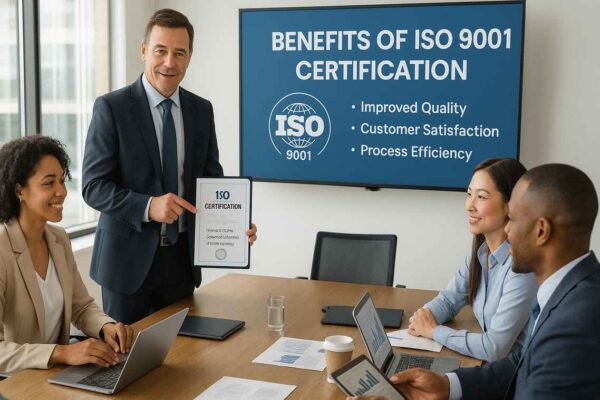
The Benefits of ISO 9001 Certification
There are so many Benefits of ISO 9001 Certification
Estimated reading time: 9–11 minutes
Key takeaways
ISO 9001 is a globally recognized quality management standard. When you earnISO 9001, you prove your business can deliver consistent quality, meet regulations, and improve over time. The benefits ofISO 9001 certification touch every part of your organization—from happier customers and smoother processes to stronger credibility, lower risk, and easier growth.
Table of Contents
What Is ISO 9001 Certification and Why It Is Important
ISO 9001 Quality Certification
Quality Management Certificate ISO 9001
Benefits of ISO 9001 Certification
Introduction
ISO 9001 is the world’s most widely used quality management standard. It sets out what a good quality management system (QMS) looks like—so you can deliver consistent products and services that meet customer and regulatory requirements. That’s the heart of ISO 9001 quality certification, and it’s why thousands of organizations use it to drive better results.
What will you learn here? Exactly how the benefits of ISO 9001 certification can add value to your business—quality, efficiency, and competitiveness included. If you want the short version: this certification helps you build stable processes, track performance, and keep improving over time. The result is happier customers and a more resilient business. For an overview of these benefits, see the British Assessment Bureau’s summary of outcomes like fewer errors, lower costs, and stronger bids for new work.
ISO and ASQdescribe ISO 9001 as a way to prove you can consistently meet both customer needs and regulations. In plain terms—your house is in order, and you can show it. See ASQ’s ISO 9001 resource and ISO’s guide.
Define ISO 9001 Certification
Let’s define ISO 9001 certification in simple terms. To define ISO 9001 certification: it’s a formal acknowledgment by an accredited certification body that your organization’s QMS meets the ISO 9001 standard. Think of it as a third-party stamp of trust. You’ve built a system to deliver quality on purpose, not by accident. (https://falconquality.com/basic-requirements-for-iso-9001-certification/)
What is ISO 9001 certification and why it is important? It matters because the standard is global. Your certificate says your processes are consistent and controlled in a way people understand worldwide.
How you get certified:
An accredited auditor reviews your processes, documentation, and evidence of improvement.
They check if your QMS fulfills ISO 9001’s requirements.
If you meet the bar, you get certified. But it’s not one-and-done—you’ll keep being checked to make sure you stay on track.
Why standardization? It creates uniform ways of working across teams and locations. Uniformity builds reliability, which builds confidence with customers. And that’s the foundation for sustainable growth. You create a stable core so your business can scale without falling apart when things get busy. For the official framing, ASQ and ISO lay out the purpose and mechanics clearly: ASQ’s ISO 9001 and ISO’s official guide.
What Is ISO 9001 Certification and Why It Is Important
So, what is ISO 9001 certification and why it is important in practice? Two big ideas:risk-based thinkingandsystematic process control.
Risk-based thinking:You identify where things might go wrong and set controls so they don’t. This reduces surprises.
Process control:You document how work gets done, train people to follow it, and monitor performance. When gaps show up, you fix them and make improvements stick.
The certification process requires real evidence:
Procedures and records that match the standard
Measurable objectives and results
Internal audits and corrective actions (https://falconquality.com/how-to-conduct-internal-audit-for-iso-9001/)
Management reviews that drive decisions
And you don’t just pass once and forget it. Businesses undergo periodic assessments to maintain certification. That rolling cycle keeps improvement alive.
Why pursue certification?
It boosts credibility with clients and stakeholders who look for proven quality systems. Many buyers trust suppliers with ISO 9001 because it reduces their risk.
It helps you meet regulatory or customer-specific requirements without guesswork.
It improves operational efficiency and product/service quality. When your processes are clear, errors go down and delivery gets smoother.
For more on the standard’s structure and intent, checkASQ’s overview. For a practical look at the outcome benefits—like better customer satisfaction and lower costs—see this plain-English guide:https://www.9001simplified.com/learn/game-changing-benefits-of-iso-9001.php.
ISO 9001 Quality Certification
ISO 9001quality certificationfocuses on one thing: quality management. It’s part of the ISO family of standards that cover different topics (like environment or safety), but 9001 is squarely about building aQMSthat delivers consistent results and improves over time.
Quick contrast with another ISO standard you might know:
So while these standards can work together, ISO 9001 strictly focuses on quality. And here’s the beauty of it: ISO 9001 applies to any organization—manufacturing, services, healthcare, government—any size, any location. If you deliver something and want to do it reliably, this standard fits.
Quality Management Certificate ISO 9001
Let’s talk about getting the certificate—step by step. Earning a quality management certificate ISO 9001 isn’t about fancy binders. It’s about building a system that actually works day to day. Here’s a simple roadmap:
Run a gap analysis
Compare your current practices to ISO 9001 requirements.
Spot missing procedures, unclear roles, inconsistent forms, or weak records.
Implement and document your QMS
Create or refine processes for key areas (sales, design, production/service, purchasing, delivery, support).
Set quality objectives and metrics. Keep it practical—measure what helps you improve.
Train your team. People need to know the “why” as much as the “what.”
Test and correct
Do internal audits to see if your processes are followed and effective.
Fix issues and record corrective actions so improvements stick.
Arrange the external audit
Select an accredited certification body.
Host the audit, address findings, and close any nonconformities.
Keep improving (forever)
Management reviews, internal audits, corrective actions, and updates to processes are ongoing.
Plan for surveillance audits and recertification, which keep you sharp.
Try our free gap analysis worksheet to help you get started on your ISO 9001 certification journey.
Why bother? The benefits of ISO 9001 certification pile up fast:
More trust from customers and partners because your quality system is clear and verified.
Better process consistency, sharper risk management, and real cost savings from fewer errors and less rework.
For structure and steps, review ASQ’s guide to ISO 9001 and the official ISO overview:https://www.iso.org/files/live/sites/isoorg/files/store/en/PUB100369.pdf. To understand the step-by-step process in detail, refer to How to Get ISO 9001 Certification.
Benefits of ISO 9001 Certification
Let’s dig into the benefits ofISO 9001 certificationyou can actually feel in daily operations.
Enhanced Customer Satisfaction
When you deliver consistent quality, customers notice. It’s easier to set expectations, meet them, and fix issues fast when they pop up. That boosts loyalty, which leads to repeat business and positive word-of-mouth. For a practical explanation of this ripple effect, see: https://www.9001simplified.com/learn/game-changing-benefits-of-iso-9001.php
How you get there:
Clear processes reduce variation.
Customer feedback loops reveal what to fix next.
Corrective actions make solutions durable, not temporary.
Improved Process Efficiency
Standardized procedures minimize errors and reduce rework. You waste less time hunting for the “right way” because it’s written down and trained. And the thing is, when people know the process and see the results, they help improve it.
Two big levers:
Documentation that’s clear and useful (not paperwork for paperwork’s sake).
Continuous monitoring so you spot drift and correct it early.
For a helpful overview of these gains, check: https://www.british-assessment.co.uk/insights/benefits-of-iso-9001-certification/ and the ASQ resource.
Market Competitiveness
ISO 9001 can be a differentiator. Some buyers require it; others use it as a strong signal that you’ll deliver. So yes, it can open doors to new markets and bigger contracts.
Where it helps:
Pre-qualification for tenders that expect ISO 9001.
Stronger supplier evaluations—your QMS reduces perceived risk.
Clear proof of quality practices when entering new regions or sectors.
For a quick read on how certification helps you stand out, see: https://www.british-assessment.co.uk/insights/benefits-of-iso-9001-certification/ and ISO’s overview.
Regulatory Compliance
ISO 9001 helps you show adherence to legal and industry requirements. You build compliance into your processes instead of treating it like a last-minute scramble. That reduces the chance of fines or legal trouble, and it builds confidence with regulators and customers alike.
Core mechanics:
Identify applicable requirements.
Bake them into procedures and controls.
Keep records that prove you did what you said.
See theASQ resource and ISO guide for how compliance fits within a QMS.
Employee Engagement and Training
A great QMS is a team sport.ISO 9001encourages a culture of quality where employees help solve problems and improve processes. And with structured training, people develop skills that stick—communication, root-cause analysis, process thinking.
Why this matters:
Clear roles reduce confusion.
Training builds confidence and competence.
Involving employees in improvements boosts buy-in and results.
For practical benefits tied to engagement and training, see:https://www.9001simplified.com/learn/game-changing-benefits-of-iso-9001.php
Risk Management
Risk-based thinking is baked intoISO 9001. You identify what could go wrong, prioritize risks, and put controls in place. That makes your organization more resilient—able to keep going even when things get messy.
What this looks like:
Risk registers focused on real operational risks.
Preventive actions that stop problems before they start.
Evidence that controls work, updated when conditions change.
The ISO guide explains how risk and continuity fit together.
Why ISO 9001 Certification Is Important for Your Business
Let’s talk long-term. Sustained certification fosters continuous improvement. You’re not chasing one-time fixes—you’re building habits that make your business stronger every quarter. Management reviews align priorities. Internal audits keep you honest. Corrective actions turn pain points into better processes.
Why this powers growth:
Your credibility rises with customers and partners.
Your operations get easier to scale because they’re process-driven.
Your team gets used to solving problems at the root, not patching symptoms.
Real-world outcomes? Many companies report higher profits and market expansion after implementing ISO 9001 — thanks to fewer defects, better delivery performance, and stronger customer trust. If you want a relatable, non-jargony walkthrough of these results, this guide is worth a look: https://www.9001simplified.com/learn/game-changing-benefits-of-iso-9001.php. Additionally, understanding the challenges and how to overcome them can be beneficial: https://falconquality.com/iso-9001-implementation-mistakes-small-businesses-make/.
And yes, small businesses benefit too. The standard scales to your size—start simple, build what you need, and grow from there. The discipline you build now saves headaches later.
Conclusion
ISO 9001 quality certificationhelps you deliver consistent results, satisfy customers, and keep improving. The headline benefits ofISO 9001 certificationare hard to ignore: higher customer satisfaction, tighter process efficiency, stronger competitiveness, and better compliance—with less risk along the way. When you treat the standard as a system to run your business, not just a certificate, you get a flywheel of improvement that supports long-term growth and a stronger reputation.
Call to Action
Ready to start? Your next steps are simple and focused:
Perform a gap analysis to see where you stand.
Train your team on the basics of ISO 9001 and your key processes.
Choose a reputable certification body and plan your external audit. (https://falconquality.com/iso-9001-certification-body-guide/)
Try our free gap analysis worksheet to help you get started on your ISO 9001 certification journey.
And for trusted guidance, bookmark these two resources:
FAQs
What is ISO 9001 certification and why it is important for small businesses?
It proves your processes meet an international quality standard. That builds trust, helps you win work, and creates structure so you can grow without chaos.
How long does it take to earn a quality management certificate ISO 9001?
Timelines vary based on your starting point. The key steps—gap analysis, implementation, internal audit, and the external audit—can be planned in phases so you keep business running.
Do service companies benefit from ISO 9001 quality certification?
Absolutely. ISO 9001 applies to services, manufacturing, healthcare, and more. If you deliver outcomes to customers, the standard fits.
What evidence do auditors look for during certification?
Documented processes, training records, internal audits, corrective actions, management reviews, and results that match your objectives.
Will ISO 9001 help with regulatory compliance?
Yes. The standard guides you to identify and meet applicable regulations and to keep records that demonstrate compliance.
How does ISO 9001 improve customer satisfaction?
By standardizing processes, reducing errors, and responding to feedback quickly. Consistency builds trust, which drives loyalty.
Do we need special software to meet ISO 9001?
No. Tools can help, but the core is a clear, working QMS. Start with simple documents and grow as needed.
Conclusion & Next Steps
ISO 9001 isn’t about paperwork—it’s about building a smarter, steadier business. Start with a gap analysis, train your team, and set a realistic timeline. Then book a readiness check and your external audit.
If you’re ready to move, grab this:
And keep these on your desk:
You’ve got this. Make the first step small, clear, and doable. The rest gets easier.
Sources
British Assessment Bureau: Benefits of ISO 9001 Certification— https://www.british-assessment.co.uk/insights/benefits-of-iso-9001-certification/
ASQ: ISO 9001 Quality Management— https://asq.org/quality-resources/iso-9001
ISO: “ISO 9001 – Quality Management” Guide (PDF)— https://www.iso.org/files/live/sites/isoorg/files/store/en/PUB100369.pdf
9001 Simplified: Benefits of ISO 9001— https://www.9001simplified.com/learn/game-changing-benefits-of-iso-9001.php
